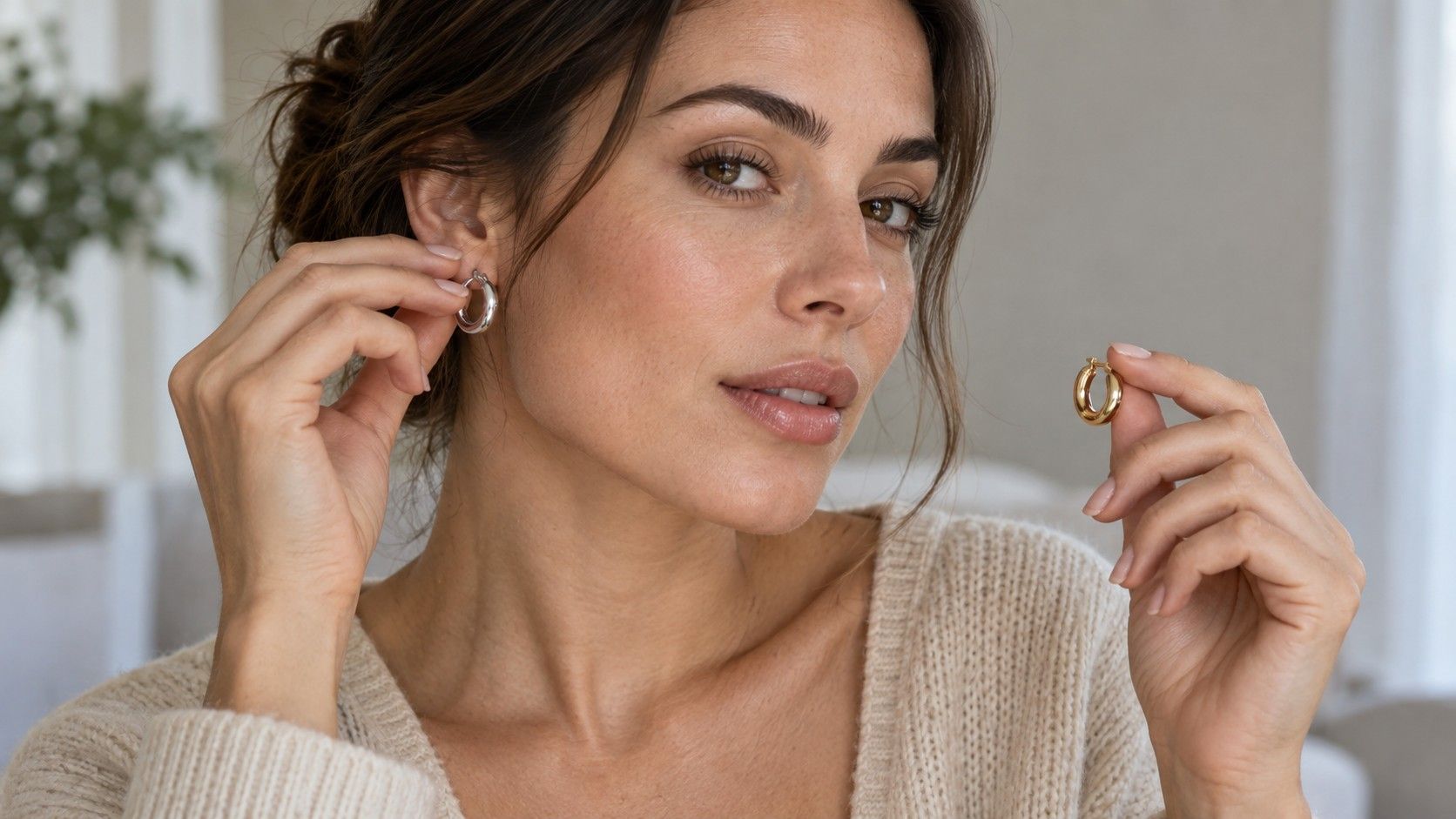
The gold or silver test sounds simple until the gold option is a fine chain and the silver option is a large polished hoop. You may prefer one immediately, but the comparison has changed size, shine, shape, and color together. Jewelry is worth testing because you actually wear it, not because it can reveal a definitive seasonal identity. With a fairer setup, you can work out which metal finishes you like near your face, which suit particular clothes, and whether there is any reason to choose between them at all.
Start with pieces that differ mainly in color
Find two pieces of roughly similar size, shape, and finish. Small gold-colored and silver-colored hoops make a more readable pair than an ornate pendant against a plain stud. If you own only mismatched pieces, compare them anyway for the purchase or outfit you have in mind. Just keep the conclusion specific to those items rather than assigning the result to every metal in that color family.
Use indirect daylight and face the window so both sides of your face receive reasonably even light. Switch off a nearby warm lamp. Put on a quiet-colored top and move away from vivid curtains or walls that may influence the reflected light. A jewelry shop's bright spotlights can make polish and sparkle especially noticeable, which may be enjoyable without answering your color question.
Try each piece in the same position. If you wear one gold earring and one silver earring, swap sides before judging: the lighting and the two sides of a face are seldom perfectly identical. With necklaces, keep the chain length and pendant position as close as you can. A higher pendant sits in a different relationship to the face than a long chain over a sweater.
Look at the face, then decide how much attention you want the jewelry to take
Begin by looking at your whole face in the mirror. Does one piece feel quieter beside it? Does another give the stronger contrast you want? You might notice a preference for the way one finish sits beside your hair, lipstick, or eye makeup. Those are useful styling observations. There is no need to translate every pleasant effect into a claim about an underlying skin category.
Then look at the jewelry itself. Sometimes the brighter piece is exactly right because the outfit needs a clear focal point. At other times you want a chain that almost disappears against the neckline. “It blends in” and “it stands out” describe different effects, and either can be desirable. Decide which effect suits the occasion before declaring a winner.
Give the first impression a second chance by reversing the order. Set both pieces down, then try the second one first. If you still prefer the same option, note why in ordinary words: less distracting, better with the shirt, or a pleasing contrast with the hair. If you keep changing your mind, both may work. A tie is useful permission to shop by design and comfort.
Try finish and scale before rejecting an entire metal family
A highly polished yellow-gold necklace and a brushed pale-gold necklace can feel surprisingly different in an outfit. Likewise, a bright silver cuff, a fine silver chain, and a darkened silver-colored pendant do not create the same impression. Reflective surfaces catch the surroundings and shift as you move. The finish deserves its own comparison rather than being hidden inside a gold-versus-silver verdict.
If a metal seems too strong, test a smaller piece or a less reflective finish before abandoning it. A narrow hoop may give enough warmth without the visual weight of a wide, shiny one. If a delicate chain seems lost, a larger link may supply the presence you wanted. Scale can explain a preference that initially looked like a temperature issue.
Rose gold is another option to try, with the same care about finish and size. It is not a guaranteed compromise for everyone who likes both yellow and white metals. Compare the actual item beside your face and your clothes. Jewelry color descriptions cover a range of appearances, so buying from a name alone can leave you with something quite different from the piece you liked in a photograph.
Use a photograph to record the choice, with a few limits
A gold or silver test photo is handy when you want to remember a pair you tried or compare it with clothes at home. Keep the camera position, lighting, and framing steady between shots. Avoid visible beauty filters and deliberate warmth adjustments. Take the pictures close together in time, and check the saved files rather than relying entirely on a live preview.
Look for changes beyond the jewelry. If the wall, shirt, and face all become warmer in the gold photograph, the camera or light may have changed. Automatic exposure and white balance can react to the scene. A collage of two differently processed selfies makes an attractive side-by-side image, but it may be a poor basis for a subtle color decision.
Reflective metal is particularly awkward to photograph because its appearance includes what it reflects. A piece can look almost white where it catches the window and dark where it reflects the room. Use the photo as a record of a real mirror comparison. If the screen and mirror disagree, try the pieces again rather than assuming the photograph has discovered the more accurate answer.
Let neutral, olive, and mixed results remain open
The phrase gold or silver skin tone can suggest that every person belongs firmly on one side. In practice, liking both is an ordinary styling outcome. Neutral and olive are useful descriptors in some color discussions, but a preference for mixed metals does not prove either one. Nor does a single favorite gold ring settle a warm undertone.
Separate what you can see from what you are inferring. “This silver necklace works with my gray knit” is an observation about a combination. “Therefore all my clothes must be cool” goes much further. Seasonal color analysis is an interpretive framework, and jewelry is only a small part of the appearance being considered. Repeated fabric comparisons can explore clothing choices more directly.
Try a mixed-metal piece if you enjoy both colors. It can make a gold watch and silver earrings feel connected, or simply provide a design you like. You do not need an equal amount of each metal. A dominant finish with a small accent can be easier to assess than several competing statement pieces, particularly when the outfit already contains patterned fabric or decorative buttons.
Choose for the outfit you will actually wear
Repeat the comparison with a familiar neckline and your ordinary styling. A necklace can seem completely different over a black crew neck, against bare skin in a V-neck, and layered over a soft cream sweater. Earrings sit beside the hair and frames of glasses. These relationships are part of the choice, not distractions to remove forever from a supposedly pure test.
Check existing details before buying: a bag clasp, belt buckle, watch, or jacket buttons may already establish a metal you want to repeat. Matching all of them is optional. Repetition can make an outfit feel settled, while a contrasting piece can create interest. Choose deliberately rather than treating a mixed buckle as a mistake that needs an entirely new accessory collection.
For an expensive purchase, give yourself more than a quick shop-mirror verdict. Review the return terms, try the piece with several outfits where permitted, and consider weight, fastening, and how often you would wear it. A flattering color does little for earrings you find uncomfortable. The most useful test ends with a clear purchase decision, which may be gold for one purpose, silver for another, and no single rule for the rest.